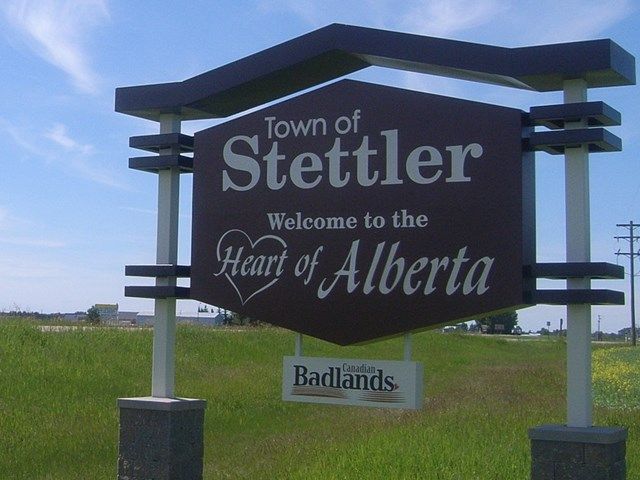
On August 12th in Stettler, Alberta, more than fifty people gathered in a town hall setting for an evening of frank, open discussion on Alberta’s future. Host Jon Sedore, founder of Alberta Independence Discussion, opened the meeting by welcoming the crowd and reminding everyone why these gatherings matter: Alberta’s political crossroads can’t be navigated by slogans and soundbites alone—it takes face-to-face conversations, straight answers, and a willingness to wrestle with uncomfortable truths.
Sedore emphasized that the goal was not to put on a partisan rally, but to give Albertans a space to ask real questions of political leaders and hear their vision without the filter of party spin or media editing. “We don’t have to agree on every solution,” he said, “but we do have to agree that Alberta’s future is worth fighting for.” He acknowledged the possibility of heated disagreement but called on attendees to treat one another with respect, noting that the fight for Alberta’s future must be built on unity of purpose, even when strategies differ. He also flagged that independence, sovereignty, and reform are not abstract theories—they are decisions that could shape the lives of everyone in the room within just a few years.
With that, he introduced the evening’s lineup of speakers, each representing different corners of Alberta’s political landscape, but all tied to the same central question: Do we fix Canada from within—or leave it behind?
The Speakers
Jeff Willerton (Christian Heritage Party) opened the night with a deeply moral framing, drawing a straight line between Canada’s political history and what he sees as the erosion of life, liberty, and faith. “Those are God’s children we’re killing and maiming,” he warned, linking cultural shifts to what he considers moral decay. He traced decades of federal overreach, climate policy impositions, and assaults on traditional values—arguing that real change will require Albertans to break free from the “blue-red paradigm” and vote for leaders committed to ending abortion, euthanasia, indoctrination of children, and the cultural engineering he believes Ottawa is driving.
Jonathan Bridges (People’s Party of Canada) shifted the conversation toward fiscal responsibility and generational stewardship. Using Norway’s $2 trillion sovereign wealth fund as a contrast, Bridges lamented Canada’s ballooning debt—$120,000 per person—while Alberta’s Heritage Trust Fund languishes at $5,000 per capita. “Instead of leaving an inheritance to our grandchildren, we’re stealing from them,” he said, urging the crowd to break from voting habits that have kept the same problems in place for decades. He made the case for smaller government, balanced budgets, and voting for principles rather than “strategic” blue-team loyalty, warning that every delay in changing course comes at the expense of our children’s inheritance.
Maxime Bernier (Leader, PPC) brought the federal outsider’s voice. A Quebecer and self-described federalist who nonetheless pledged to stand on the “Yes” side in any Alberta referendum, Bernier argued that both Quebec and Alberta have been lied to repeatedly by Ottawa’s power brokers. “If you vote no, nothing will change—if you vote yes, at least you have a chance,” he told the crowd. He laid out three possible outcomes of a “Yes” vote—true constitutional reform, outright independence, or even alignment with the U.S.—and urged Albertans to use a referendum as leverage for real change, warning that a “No” simply signals Ottawa to ignore the province entirely.
Cam Davies (Alberta Republican Party) reminded the room that independence sentiment in Central Alberta is stronger than media suggests, with younger Albertans often more in favour than their parents but less visible at events. While Quebec’s referendums were often a negotiating tactic, Davies stressed Alberta’s goal is different: “Independence isn’t a negotiation tactic for us—it’s an exit strategy.” He urged starting now on Alberta-first institutions—policing, tax collection, pensions, and immigration—so Ottawa can’t use them as leverage if a vote is called. He also criticized the province’s petition requirements, warning they drain time and momentum. “It doesn’t take a petition to do the right thing—it takes political will,” he said, calling independence a calculated risk worth taking over the “terrifying certainty” of staying in Confederation.
Ron Robertson (Independence Party of Alberta) took a historical and hard-line approach, connecting Alberta’s creation in 1905 to a pattern of imposed governance and resource control. He argued that Canada is already under a form of Marxist influence, pointing to Pierre Trudeau’s ideological history and current federal policies. “We can’t have sovereignty inside a system designed to control us,” Robertson said, advocating for a unilateral declaration of independence, a constitutional republic with strict limits on government power, and equal treatment for all Albertans without “special rights” enshrined in law.
Open Forum – Where the Room Comes Alive
When the formal speeches wrapped, the tone of the evening shifted into something more electric. The mics moved through the audience, and what followed was a rapid-fire exchange of ideas, challenges, and genuine curiosity.
The first round of questions tackled one of the thorniest issues in Alberta politics: the Indian Act. Audience members wanted to know exactly how each party envisioned handling Indigenous relations in an independent Alberta. Responses from the panel converged on the principle of equal rights for all Albertans, while also acknowledging the need to dismantle a system that has trapped many in dependency and stripped away property rights. “If everyone’s truly equal, there should be no special rights for anyone—and no second-class citizens either,” one speaker said to nods around the room.
Another hot topic was the timeline for independence. One attendee openly admitted they still wanted to give Canada “one last chance” before breaking away, prompting a mix of agreement and pushback from the panel. Davies cautioned that the damage done in even a few more years under the current federal direction could be irreversible. Bernier stressed that a referendum vote could serve as the “last chance” for Ottawa to offer meaningful reform—if rejected, Alberta should be prepared to leave. Robertson warned that delay has been the independence movement’s Achilles heel for decades, and that hesitation risks losing the momentum building now. “Four more years under this system will do damage we can’t undo,” he said.
The conversation also turned inward, focusing on unity—or lack of it—within the independence movement itself. Several attendees wanted clarity on why there are multiple independence parties, and how that might split the vote. The speakers explained the distinction between registered political parties and organizations like the Alberta Prosperity Project, which is an educational society rather than a political vehicle. Robertson and Davies pointed to their memorandum of understanding as an example of cooperation and called on others to follow suit, warning that running multiple pro-independence candidates in the same riding only helps the federalist parties. “Five pro-independence names on one ballot just guarantees a win for the people who want us to fail,” one speaker bluntly said.
Throughout the discussion, there was a noticeable absence of hostility. Even on points of disagreement, the exchanges stayed constructive, with speakers thanking attendees for hard questions and attendees showing openness to hearing answers they might not agree with. That willingness to engage—to challenge each other without shutting each other down—is what kept the energy high in the room right through to the breakout conversations afterward.
Key Topics Covered
Historical federal overreach and resource control since Alberta’s founding
“We were never meant to be an equal partner in Confederation—we were designed to be a resource colony.”Moral and cultural decline under Ottawa’s policies
“When the government blames you for their crimes, you’re already living under tyranny.”Fiscal mismanagement and intergenerational debt
“We’re not leaving our kids an inheritance—we’re leaving them the bill for our mistakes.”Referendum strategy: negotiation tool vs. direct exit
“A ‘No’ vote tells Ottawa they can keep ignoring us—a ‘Yes’ at least forces them to the table.”Building Alberta-first institutions before a vote
“If we wait until after a referendum to build them, Ottawa will make sure we never get the chance.”Risks of delay in pursuing independence
“Four more years under this system will do damage we can’t undo.”Equal representation, Senate reform, and dismantling the Indian Act
“If everyone’s truly equal, there should be no special rights for anyone—and no second-class citizens either.”The need for unity among independence parties and organizations
“Five pro-independence names on one ballot just guarantees a win for the people who want us to fail.”
Closing Note:
The Stettler meeting demonstrated that Alberta’s political future isn’t just a matter of party platforms—it’s forged in rooms where people are willing to speak plainly, listen intently, and test their convictions against opposing views. Over fifty voices filled the hall, not in agreement on every point, but united in taking the issues seriously enough to show up and engage.
In that exchange—where tough questions met candid answers—the key themes of the night came to life: the urgency of action, the tension between caution and boldness, and the recognition that unity will matter more than perfection. These are not abstract talking points; they are the living, breathing conditions that will shape whether Alberta charts its own course or remains tied to the one set in Ottawa.
If there was one takeaway from Stettler, it’s that discussions like this are not just commentary on the times—they are part of the work itself. What happens in these rooms will determine what happens beyond them.
Disclaimer: Alberta Independence Discussion (AID) event reports are prepared as summaries of public discussions and are intended to reflect the range of views expressed by speakers and participants. These reports are not verbatim transcripts. Statements made during events are the responsibility of the individual speaker and do not necessarily represent the views of AID. Any factual claims should be independently verified. AID event summaries are drafted with the assistance of AI technology based on event notes, recordings, and transcripts, and are reviewed for accuracy and clarity before publication.